
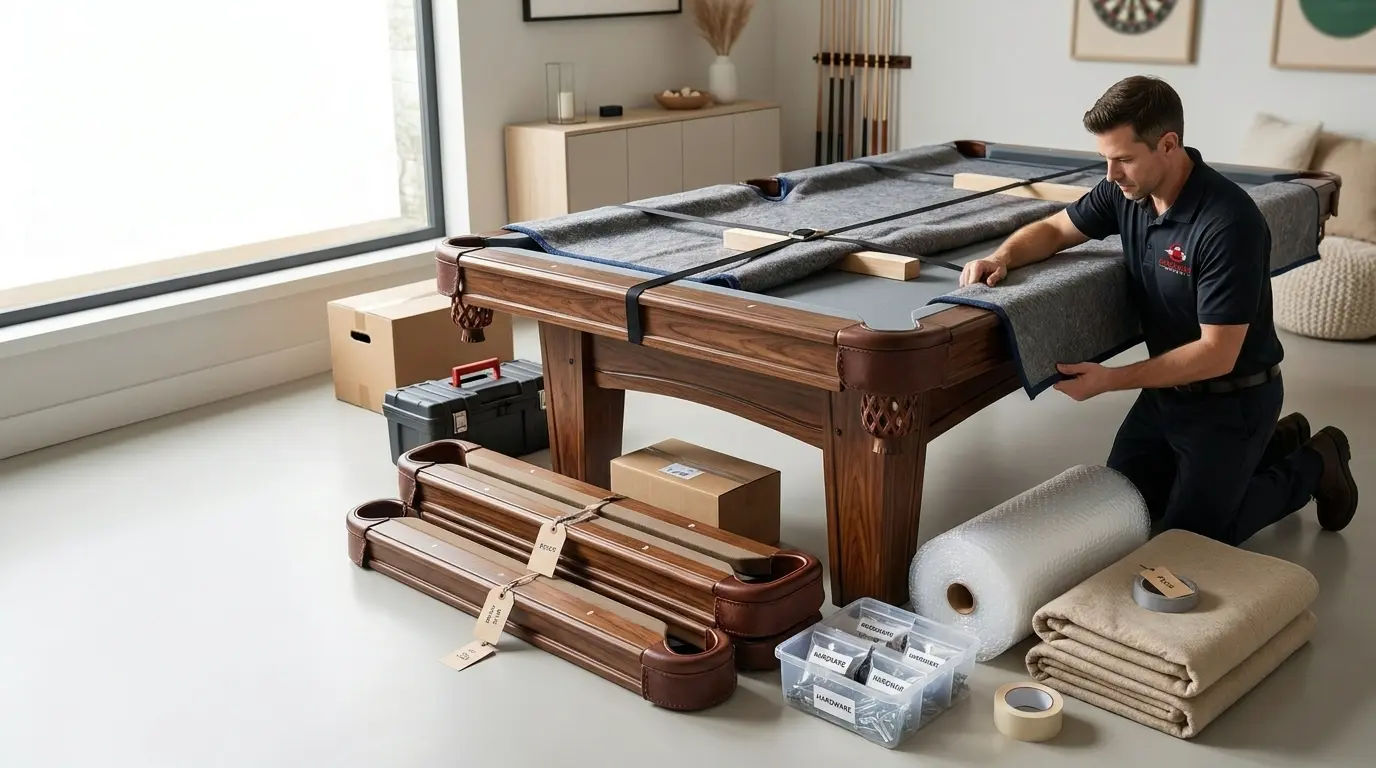
How to Move a Pool Table Without Damaging Its Components
A pool table needs more care than ordinary furniture during a move. Its frame, rails, pockets, cloth, and playing surface can be damaged by impact, twisting, or incorrect handling. The right moving method depends on the table’s construction, so check its manual and arrange help from an experienced pool-table specialist if you are unsure how it should be dismantled or transported.
For general household packing and moving, see our guide to packing fragile items before moving. Pool-table disassembly and specialist handling should be arranged separately with a qualified professional.
1. Identify the table and plan the route
Before moving day, identify the table’s make and model if possible. Check the owner’s manual for instructions specific to its construction. Pool tables can differ in how their rails, pockets, cloth, playing surface, and frame are attached. Do not assume that a method used for one table will work for another.
Measure the route from the table’s current location to the vehicle, then from the vehicle to its new position. Check doorways, corridors, corners, stairs, and lift access for tight turns or restrictions. Clear the route before handling begins.
Prepare the destination as well. Make sure there is enough room to assemble the table and that the planned location is suitable. If access is difficult or the table is unusually heavy, arrange experienced help in advance.
2. Decide who should handle the disassembly
Many pool tables are designed to be dismantled for a move, but the exact process varies by model. Slate tables can be particularly heavy and vulnerable to damage if they are lifted, twisted, or poorly supported. Moving a table while it is assembled may put stress on its playing surface and frame.
If you are unsure how the table is constructed, how its parts are secured, or what equipment is needed, consult a pool-table specialist. Do not force stuck components loose or attempt to lift heavy parts without suitable help and equipment.
3. Photograph, label, and organize the parts
Before removing anything, take clear photographs of the table from several angles. Include the underside, rail connections, pocket attachments, and any fittings that may be difficult to identify later.
Keep screws, bolts, washers, and other small hardware in separate labelled bags. Identify which component each bag belongs to, and keep the bags with the related parts. This can make reassembly easier and help prevent hardware from being mixed up or lost.
4. Protect the rails, pockets, and cloth
Rails and pockets can be scratched, dented, or damaged if they are dropped or allowed to rub against other items. Once they have been removed according to the table’s instructions, protect them separately and keep their hardware close by.
The cloth needs particular care. Depending on the table, it may be stapled or glued in place. Removing it incorrectly can tear or stretch it, so follow the manufacturer’s instructions and avoid pulling forcefully. If you are uncertain whether the cloth can be removed and reused, ask a specialist before proceeding.
5. Treat the playing surface as a specialist component
The playing surface may be made from slate or another material, and its weight and handling requirements can vary considerably. Slate can chip or crack if it is dropped, twisted, or inadequately supported. Do not lift it alone, drag it across the floor, or improvise a carrying method.
If the table has multiple slate sections, keep track of their original positions and orientation. Protect each piece from impact and secure it so it cannot slide or tip during transport. If the playing surface is cracked, unusually heavy, or difficult to access, leave the work to an experienced pool-table specialist.
6. Wrap and secure each component for transport
Use protective materials suited to each part. Moving blankets or other suitable padding can help protect finished surfaces from scratches and knocks. Keep small fittings in labelled bags, and pack delicate components so they cannot be crushed by heavier items.
Secure the parts in the vehicle so they cannot shift, slide, or tip during the journey. Keep the playing surface supported according to the table’s requirements, and do not place heavy household items on top of rails, pockets, cloth, or other fragile components.
7. Reassemble and check the table carefully
At the new location, follow the manufacturer’s instructions or the specialist’s plan for reassembly. Check that the frame and legs are properly assembled before the playing surface is put back in place. The surface, seams, cloth, and rails may need careful adjustment, and the table should be level before it is used.
Do not assume the table is ready simply because it has been reassembled. If the playing surface is uneven, the cloth is damaged or loose, or the table does not feel stable, ask a pool-table specialist to inspect it before use.
Common mistakes to avoid
- Moving a table without checking its construction or instructions
- Trying to handle heavy components without enough help or suitable equipment
- Pulling or creasing the cloth during removal
- Allowing the playing surface to twist, slide, tip, or strike another surface
- Mixing hardware from different components
- Loading parts without securing them against movement
- Skipping the final inspection and levelling
Final pool-table moving checklist
Before the move, confirm that:
- The table’s make, model, and construction have been checked
- The manufacturer’s instructions or specialist guidance are available
- The full route has been measured and cleared
- Suitable help and equipment are arranged for heavy components
- Parts are photographed and hardware is labelled
- Rails, pockets, cloth, playing surface, and frame have a protection plan
- Components can be secured for transport
- The destination is ready for reassembly and levelling
Moving a pool table safely depends on its design, condition, access route, and the people and equipment available. When the disassembly or handling requirements are uncertain, consult an experienced pool-table specialist rather than risking damage to the table or injury to the people moving it.
Frequently asked questions
Can I move a pool table without taking it apart?
It depends on the table and the move. For a full relocation or difficult access, disassembly is commonly recommended. Check the manufacturer’s instructions or consult a pool-table specialist before moving an assembled table.
How do I protect a pool table’s cloth during a move?
The correct method depends on how the cloth is attached. Follow the table’s instructions, avoid pulling or creasing it, and ask a specialist if you are unsure whether it can be removed and reused.
What is the most important part to protect?
The playing surface needs particular care because it may be heavy and vulnerable to chipping or cracking. The rails, pockets, cloth, frame, and hardware also need to be protected and kept organized.
Should I hire a specialist to move a pool table?
Get experienced help if the table is heavy, valuable, unusually constructed, or difficult to access—or if you are unsure how to dismantle, transport, or reassemble it. A specialist can advise on the table’s particular requirements.
What should I check after the pool table is reassembled?
Check that the table is stable and level, and that the playing surface, cloth, and rails are correctly positioned. If anything looks uneven, damaged, or loose, have a pool-table specialist inspect it before use.
Planning a household move in Abu Dhabi?
Crescent Movers can discuss your general household moving requirements. For pool-table disassembly, specialist handling, and reassembly, arrange an experienced pool-table professional.
Contact Crescent Movers