
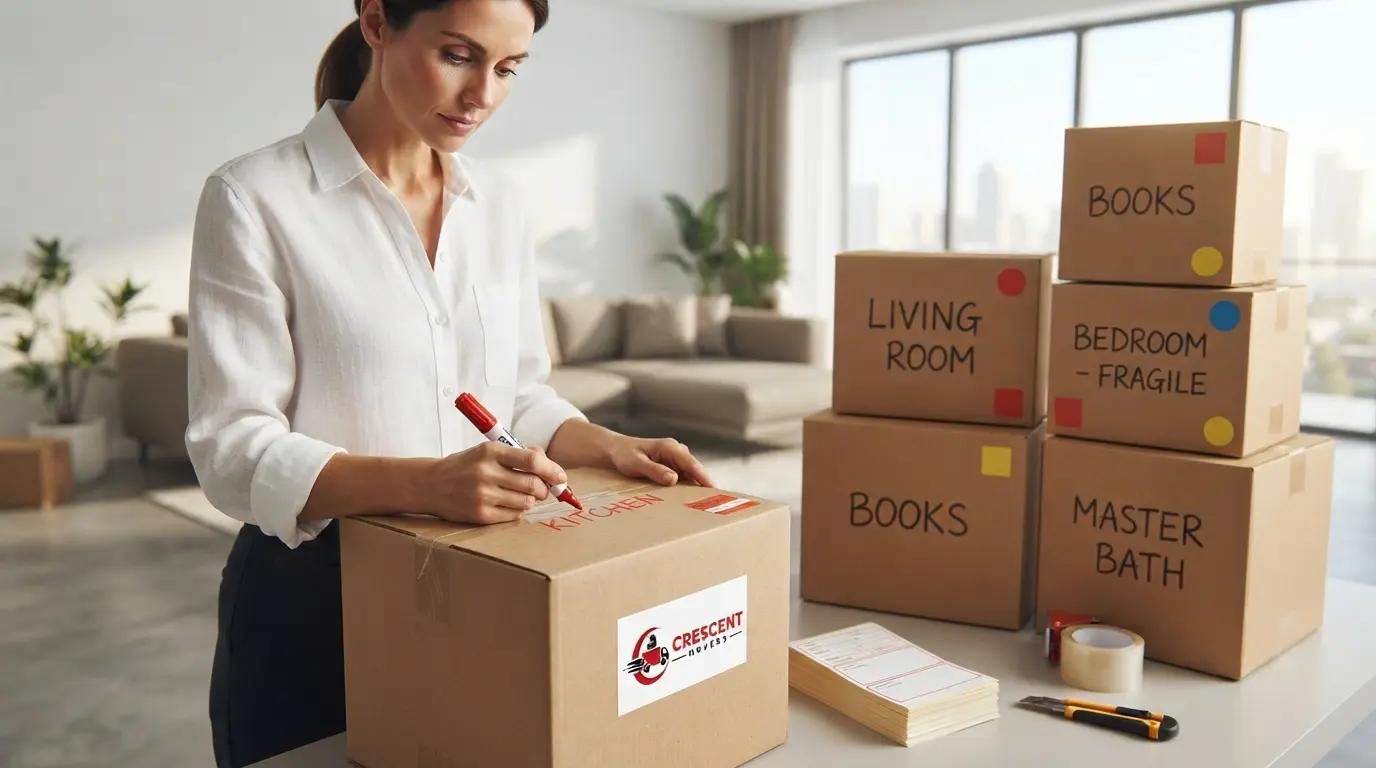
How to Label Moving Boxes So They Are Easy to Find
Packing your belongings is one part of preparing for a move, but finding everything after arriving at your new home can be another challenge. When dozens of identical cardboard boxes are stacked in different rooms, locating a particular item can take longer than expected. A box marked “Kitchen” might contain plates, mugs, cooking utensils or small appliances, leaving you unsure which carton to open first.
Learning how to label moving boxes properly helps you organize your belongings, direct boxes to the correct rooms and make unpacking more manageable. A simple system using room names, contents descriptions, box numbers and handling instructions can make a noticeable difference.
Whether you are moving from an apartment, villa or family home in Abu Dhabi, the key is to establish a consistent labelling method before packing begins. You do not need complicated equipment or an elaborate inventory. Clear information and a little preparation can help you keep track of your belongings throughout the move.
1. Write the Destination Room on Every Box
The first step is to identify where each box belongs in your new home. Write the destination room in large, clear letters so anyone helping with the move can understand where the carton should go.
For example, you might use labels such as:
- Kitchen
- Main Bedroom
- Children's Bedroom
- Living Room
- Home Office
- Bathroom
- Storage Room
Use room names that match your new property rather than relying on the names of rooms in your current home.
For instance, items from an old spare bedroom might be intended for a home office in your new property. Labelling the box “Home Office” makes its destination clear and reduces the need to move it again after unloading.
If your new home has several bedrooms, use specific descriptions such as “Bedroom 2” or “Guest Bedroom” instead of writing “Bedroom” on every carton.
Before packing starts, decide which names you will use for each room. Keeping these names consistent makes it easier for family members and anyone assisting with the move to follow the same system.
2. Describe the Contents Instead of Writing Only the Room Name
A room label tells you where a box belongs, but it does not necessarily tell you what is inside.
Imagine arriving at your new home and needing a kettle. You might find several boxes labelled “Kitchen,” but opening each one to locate a small appliance can be frustrating.
Add a short description of the main contents to make each label more useful.
For example:
| Instead of writing | Write something more specific |
|---|---|
| Kitchen | Mugs, cups and glasses |
| Bedroom | Bed sheets and pillowcases |
| Living Room | Photo frames and decorations |
| Bathroom | Towels and toiletries |
| Home Office | Notebooks, stationery and files |
| Children's Room | Books, toys and night-light |
| Kitchen | Pots, pans and cooking utensils |
You do not need to list every object inside the carton. Focus on the items you might need to locate quickly.
This gives you the destination and a useful description without making the label unnecessarily complicated.
Avoid vague descriptions such as “Miscellaneous,” “Stuff” or “Various Items.” These labels offer little assistance when you need to find something specific.
3. Use Colour Coding to Identify Different Rooms
Colour coding is another practical way to organize moving boxes. By assigning a different colour to each room, you can recognize the destination of a carton quickly.
You can use coloured tape, stickers or markers. Choose a system that is easy to maintain and simple enough for everyone involved in the move to understand.
For example:
| Room | Suggested colour |
|---|---|
| Kitchen | Blue |
| Main Bedroom | Green |
| Living Room | Yellow |
| Bathroom | Orange |
| Home Office | Purple |
| Children's Room | Red |
These colours are only examples. Choose combinations that are easy for your household to distinguish.
Once you have selected your colours, use them consistently on the corresponding boxes. You can also place a small sign with the matching colour near the entrance to each room in your new home.
This gives anyone unloading the boxes a quick visual reference.
However, colour should support written information rather than replace it. Always include the room name because not everyone will remember what each colour represents.
If you are using several colours, keep a simple reference list somewhere accessible so you can check the system whenever necessary.
4. Number Your Moving Boxes and Maintain an Inventory
Numbering boxes can be particularly helpful when you have many belongings or plan to unpack gradually.
Assign a unique number to each carton and record its contents in a notebook, spreadsheet or note on your phone.
For example:
- Box 01 — Kitchen — Plates and bowls
- Box 02 — Kitchen — Mugs and coffee supplies
- Box 03 — Main Bedroom — Bedding and blankets
- Box 04 — Home Office — Documents and stationery
- Box 05 — Living Room — Decorative accessories
The number provides a simple reference if you need to locate something without opening several boxes.
An inventory also helps you check your belongings when unloading is complete. If you have recorded 25 boxes, you can compare the list against the boxes that arrive at your new home.
For a small move, a handwritten list may be sufficient. For a larger household, a spreadsheet or searchable phone note can be more convenient.
Remember to update the inventory if you move items between cartons while packing. Otherwise, your records might no longer match the contents.
Keep the inventory accessible throughout the move rather than packing it into a box that will remain sealed until later.
5. Clearly Mark Fragile and Heavy Boxes
Some boxes need special handling instructions in addition to their destination and contents.
Items such as glassware, decorative pieces, framed photographs and other breakable belongings should be packed appropriately and clearly identified.
Use visible labels such as:
- FRAGILE
- HANDLE WITH CARE
- THIS SIDE UP
Add arrows when a carton needs to remain upright.
Place these instructions where they can be seen easily, even when boxes are stacked. A warning written only on the top may become hidden during transport.
Remember that labelling alone does not protect fragile belongings. Use suitable packing materials, provide cushioning and avoid leaving excessive empty space inside the carton. For more guidance, see our guide to packing fragile items before moving.
Heavy boxes should also be identified when appropriate. Books, tools and other dense objects can make a carton difficult to lift if too many are packed together.
Instead of placing all your books in one large box, distribute them across smaller cartons that are easier to carry.
Keep labels simple and readable. The purpose is to communicate important handling information clearly, not to cover the entire box with unnecessary instructions.